
AI is not a Software Engineer: Why Context, Architecture, and Security Still Matter
The hype cycle around AI in software engineering has moved fast. Depending on who you ask, we're either on the verge of fully autonomous development teams or one prompt away from replacing years of engineering experience.

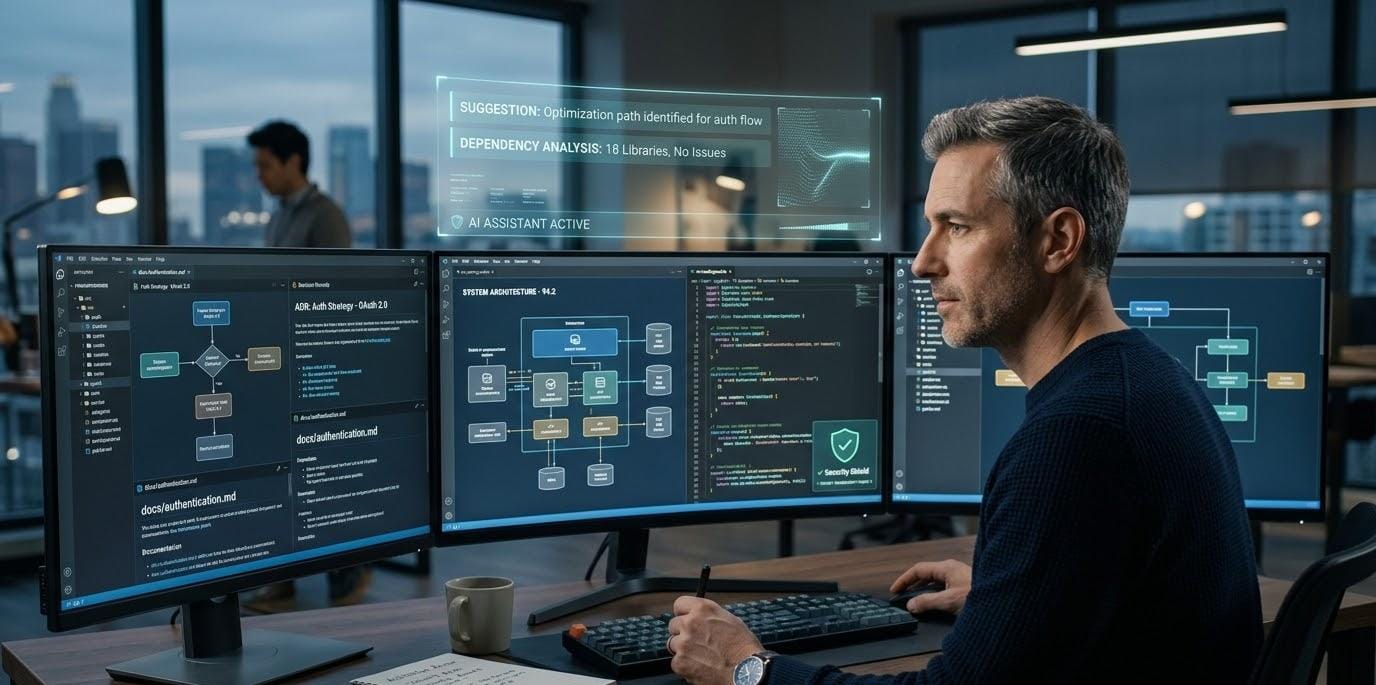
The hype cycle around AI in software engineering has moved fast. Depending on who you ask, we're either on the verge of fully autonomous development teams or one prompt away from replacing years of engineering experience.
We don't buy that narrative.
AI is useful. In the right hands, it's invaluable. But the biggest gains don't come from treating it like a magic code vending machine. They come from using it where it's strongest: planning, structuring, reviewing, stress-testing ideas, and accelerating clearly defined work.
That distinction matters.
The real value is upstream
One of the most underrated uses of AI is before any code is written.
Used properly, it can help refine scope, pressure-test assumptions, turn scattered thoughts into coherent design documents, compare implementation options, and surface edge cases that are easy to miss when we're too close to the problem. It can help turn architecture into something more concrete and actionable. It can help convert complexity into structure.
That's where it starts to become a force multiplier.
It's especially effective when the work already has shape and scope. Give it a solid specification, clear constraints, naming conventions, architectural boundaries, and known invariants, and it becomes dramatically more useful. At that point, AI can support delivery, improve speed, and reduce friction across the engineering workflow.
But that's a very different proposition from “just let it build it.”
The dangerous part is plausible output
The real risk with AI-generated code is not that it looks broken. It's that it often looks correct.
That's what makes it dangerous in serious systems.
Without enough context, AI tends to produce output that is superficially convincing but logically incomplete. It can miss domain invariants, misunderstand intent, propagate flawed patterns, or quietly introduce technical debt. Once that output is accepted into a codebase, the damage compounds. Future prompts build on the same assumptions. Bad patterns start to look like established patterns. Rework gets more expensive.
This is why “shoot and forget” AI usage is a poor engineering model. It front-loads speed and back-loads risk.
In practice, that risk is worst in exactly the environments where confidence matters most: multi-tenant systems, security-sensitive products, regulated environments, complex integrations, and anything with real operational consequences.
AI without context is guesswork
A recurring limitation with current AI workflows is context amnesia.
Teams spend time re-explaining project structure, re-stating architectural decisions, and re-establishing conventions that should already be known. That's not just a time sink. It's a quality problem. If the model doesn't understand the system, it cannot reason well inside it.
This is why the future of effective AI usage in engineering is not just “better models.” It's better context.
Instruction files. Decision records. Project-specific guides. Structured architecture documents. Defined constraints. Shared terminology. Clear boundaries around what is in scope and what is not.
In other words: institutional knowledge, made legible.
The more we can encode how a system works before asking AI to modify it, the more useful it becomes. Not because the model is suddenly wise, but because we have reduced the amount of guessing it has to do.
Security and quality still have to be designed in
And there's a broader lesson that goes beyond AI.
In good engineering, quality is not something we inspect into the system later. Security is not something we bolt on at the end. Reproducibility is not optional. Testing is not theatre. Governance is not bureaucracy for its own sake. These are design choices.
That mindset matters even more when AI enters the workflow.
If we already care about clear architecture, strong version control, reproducible infrastructure, meaningful testing, CI/CD discipline, observability, and secure defaults, AI can amplify a strong system. If we don't, it can amplify confusion just as effectively.
This is why disciplined teams tend to get more value from AI than undisciplined ones. The tool is the same. The surrounding system is not.
What is hype, and what is real?
The hype is the idea that AI can replace accountability, judgment, and business understanding.
It cannot.
It doesn't own production risk. It doesn't understand organisational trade-offs the way a responsible engineer does. It doesn't carry operational memory. It doesn't know when a technically acceptable answer is still the wrong answer in context.
The real value is more grounded.
AI is genuinely strong at gap analysis, structured drafting, pattern acceleration, and helping teams think more clearly. It can improve throughput. It can reduce friction. It can challenge assumptions. It can help engineers spend less time on repetitive reconstruction and more time on higher-order design.
That's real. But it's real because it sits inside a disciplined workflow, not because it replaces one.
Where we stand
At Cirrus Invicta, we see AI as a powerful tool, but not as a substitute for architecture, engineering standards, or security thinking.
We are far more interested in context-aware collaboration than autonomous guesswork.
That means using AI to help define, refine, challenge, and accelerate, while keeping humans responsible for system design, risk, quality, and correctness. It means treating documentation, design constraints, and institutional knowledge as strategic assets. It means recognising that the strongest engineering workflows are not the ones that surrender judgment to AI, but the ones that make judgment easier to apply.
That also means investing in the human skills that make AI collaboration effective: knowing how to prompt well, how to review and debug AI-generated output critically, and how to govern AI use at scale. These aren't soft skills; they're engineering disciplines in their own right, and teams that treat them as such are the ones pulling ahead.
AI changes the shape of software work. It doesn't remove the need for software engineering.
If anything, it makes good engineering matter more.